
Nemesis of Auckland Christians, Superintendent Naila Hassan moves to Sydney just weeks after preventing Brian Tamaki’s protest march across the harbour bridge. Hassan gained her position only after keeping her Islamic beliefs hidden. Coming from London she is well aware of the importance of the police role in covering up Islamic rape gangs, especially with media. Her first move after the Lynmall terrorist attack was to send her men around to question me, as if this site, which had gone inactive, had provoked the attack. Oz have a huge issue with immigrants and Hassan is experienced in covering things up.
This from Newslink:
Superintendent Naila Hassan moves to Sydney
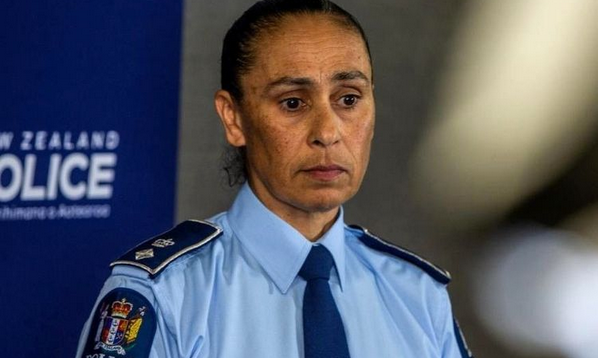
Superintendent Naila Hassan, the distinguished Commander of the Waitemat? Police District, is embarking on a two-year secondment at the Sydney-based Australian Institute of Police Management. Since graduating from the Royal New Zealand Police College in 1989, her career has been defined by transformative leadership and an unwavering commitment to ethnic representation. Her pivotal role following the March 15 tragedy, alongside her stewardship of the Hajj delegation, established her as a global symbol of unity and compassion. In Australia, she will balance a fellowship at the Australian Institute of Police Management with postgraduate studies. Superintendent Hassan remains dedicated to her New Zealand roots, pledging to return in 2027 to serve her people again.
“I am also happy that the new assignment and educational opportunity to seek higher qualifications and competence in Organisational Leadership will help me further in my career with the New Zealand Police,” she told Indian Newslink during a conversation.
Superintendent Hassan said that many members of our ethnic communities had expressed their concern that she would be away at a time when they are facing ‘threats, uncertainties and challenges.’
“While I am deeply touched by the love and respect shown by our communities, I wish to assure our people that I am temporarily shifting to Australia to improve my qualifications and experience. I will return by the end of 2027 to serve our ethnic communities in whatever role I am assigned at the New Zealand Police,” she said.
Superintendent Hassan said that leading the Waitemat? District was the greatest privilege of her career.
“With the support of our people, we navigated immense challenges, big shifts, and defining moments. Through everything, the integrity, professionalism, and unwavering commitment of our collective strength have kept us focused on what matters most: our people and the communities we serve. I am incredibly proud of what we have achieved together. I step away from this role with deep admiration, a full heart, and complete confidence in the incredible mahi that I know will continue into the future,” she said.
Born in London, Superintendent Hassan migrated to New Zealand when she was five years old. She graduated from the Royal New Zealand Police College in 1989; the Organisation was vastly different from the inclusive force it aspires to be today.
As a woman of faith entering a male-dominated environment, she navigated the complexities of institutional culture with a mix of tenacity and grace. Her early years were spent in the crucible of frontline work and prosecutions, where she developed a reputation for being both meticulous and fair. She understood early on that the legitimacy of the Police is predicated on the trust of the community, a principle that would become the North Star of her leadership.
Her ascent through the ranks was marked by a series of firsts, but her appointment as the District Commander for Waitemat? was perhaps the most significant. In this role, she oversaw a sprawling and diverse geographical area, managing hundreds of staff and the safety of hundreds of thousands of citizens.
Superintendent Hassan was never a Commander who stayed confined to the ivory tower of headquarters.
She was frequently seen on the ground, engaging with local businesses, ethnic communities, and her own staff. Her leadership style was defined by a rejection of the traditional command-and-control hierarchy in favour of a more collaborative, empathetic approach.
Among the many projects she spearheaded, Superintendent Hassan’s commitment to the Prevention First strategy stands out. She championed initiatives that addressed the root causes of crime, particularly in the realm of family harm and youth recidivism.
Superintendent Hassan set ambitious targets for her district, focusing on reducing the victimisation of vulnerable groups. She realised that success should not be measured solely by the number of arrests made, but by the number of crimes prevented and the degree to which people felt safe in their homes. Under her watch, Waitemat? saw significant advancements in how the police interacted with victims of domestic violence, ensuring that the response was timely, culturally sensitive, and survivor-centric.
The story of Ms Hassan is a testament to what can be achieved when leadership is infused with authenticity. She did not change who she was to fit the uniform; instead, she changed the uniform to fit a more inclusive vision of justice. Her career serves as a reminder that the most effective tools in a police officer’s kit are often not the tactical ones, but the human ones: the ability to listen, to empathise, and to stand in solidarity with the community during its darkest hours.
However, it was the tragic events of March 15, 2019, that cast Superintendent Hassan into the global spotlight.
Following the terrorist attacks on two Mosques in Christchurch, the Nation was shrouded in grief and fear. In the days that followed, Superintendent Hassan stood before a massive crowd at a vigil in Auckland’s Aotea Square. Wearing her uniform with pride and her hijab with solemnity, she delivered a speech that resonated far beyond the borders of New Zealand.
Her declaration that she was a proud Muslim and a leader in the New Zealand Police was a watershed moment. It was an act of profound vulnerability and immense strength that provided a sense of sanctuary to a community that felt targeted and alone. In that moment, she was more than a Police Officer; she was a symbol of national unity.
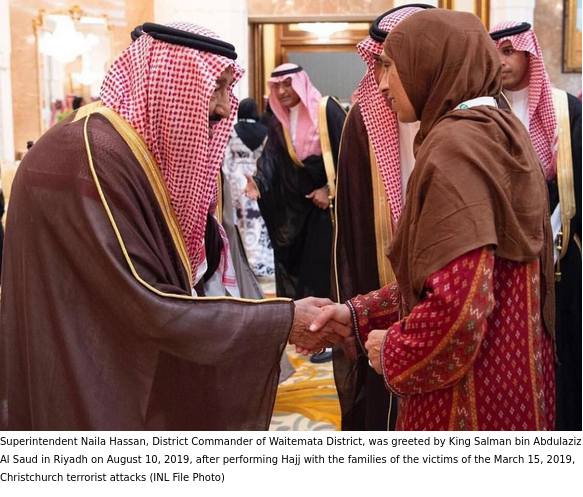
Her role in the aftermath of the attacks extended to international diplomacy and spiritual healing.
She was chosen to lead a delegation of survivors and family members of the victims on a journey to Saudi Arabia for the Hajj pilgrimage in 2020, following an invitation from King Salman.
This mission was complex, requiring delicate navigation of international protocols and the management of a group carrying immense trauma.
Superintendent Hassan handled the responsibility with her characteristic poise, serving as a protector, a guide, and a fellow mourner. By facilitating this sacred journey, she helped weave a thread of healing into the fabric of the recovery process, demonstrating that the New Zealand Police could be an instrument of peace as well as protection.
Throughout her tenure, Superintendent Hassan has been a vocal advocate for ethnic representation within the force.
She understood that if the Police are to be effective, they must look like the people they serve. She led recruitment drives specifically targeting minority communities, breaking down the barriers of suspicion that had historically existed. Her aim was not about filling quotas but about enriching the operational intelligence and cultural competence of the entire organisation.
She fostered an environment where officers felt comfortable bringing their whole selves to work, regardless of their background or creed.
As she moves to Sydney, she will carry with her a wealth of experience in high-level strategic planning and crisis management. Her secondment is a recognition of her standing as one of the most capable senior officers in the Pacific region. While her absence will be felt in the corridors of the New Zealand Police, the systems she put in place and the culture of empathy she nurtured will continue to thrive. She leaves a legacy of a Police Service that is more aware of its social responsibilities and more connected to the myriad cultures that make up New Zealand.


