
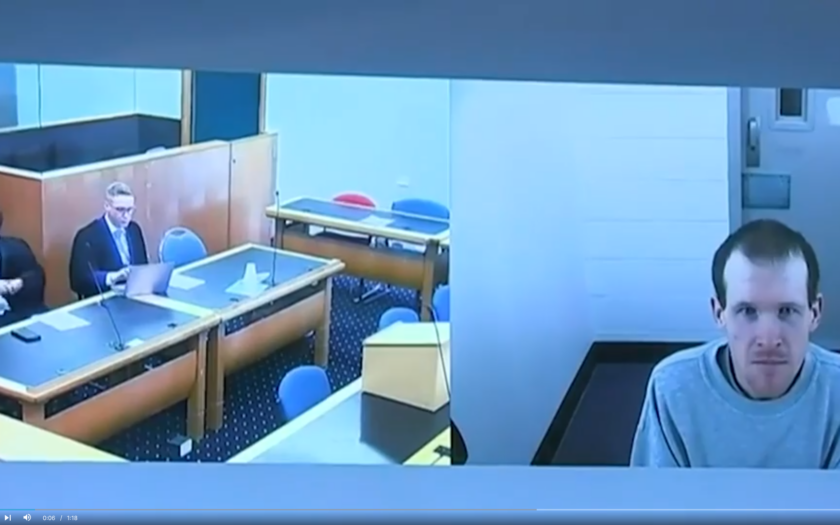
Whatever the reasons are for this appeal, as Tarrant appeals his Christchurch conviction, many are still questioning the legitimacy of the conviction to start with. Ordinary Kiwi’s have been questioning the legitimacy of the March 15 2019 event from the day it happened. Leading Muslims overseas were questioning the manifesto which contained zero ‘antisemitism’ who claimed that hating Jews is apparently the most notable trait of white suprematists. This fact alone to them indicated something about this event was not kosher. Overseas political analysts were calling it a ‘false flag’ event; an tragedy where the wrong person is framed and prosecuted.
Unknown to us in NZ, overseas military websites, frequented by the sort of people who use those sort of weapons on a daily basis, were asked “was Tarrant a Mossad agent?” Here in New Zealand local Muslims banished one of their own, Imam Ahmed Benji, for saying the same thing.
We didn’t take any notice of any of it until there was a knock on our door by the NZSIS after a trade union based website was created by Peter Hall-Jones accused us of inspiring the attack. After this we started publishing as much as we could find to defend ourselves. All video was lost when the NZ government ordered this website taken down.
More recently Counterspin Media, who are facing charges relating to the video posted under the name Brenton Tarrant, commissioned and released a report into the inauthenticity of the allegedly “live streamed” video. It is important to note that the author of this report, Gareth Jones, has previously worked on projects for NZ Police analysing digital content.
However, after the release of the US Department of Justice Epstein files, it’s become crystal clear that the ‘conspiracy theorists’ were correct all along with their claims to Islamic terrorism overseas. Epstein, trained as Mossad, financed by and working for the Rothschild family, had been blackmailing US politicians and presidents to finance Israel’s double sided wars in essence to create their Greater Israel Project. Israel needs war to gain land. Ordinary Muslims have been suckered into supporting and fighting for Israeli Secret Intelligence Service wars.
So it’s quite possible the claims of that Imam we all thought was crazy were correct, and that Tarrant’s original court case was staged with false evidence, which he can now question. To keep Tarrant quiet they will either release him or Charlie Kirk him.
This as Tarrant appeals Christchurch conviction from the NZ Herald:
In August 2020, Brenton Harrison Tarrant was jailed for life with no possibility of parole after he admitted murdering 51 people and wounding another 40 in the Christchurch terror attack.
The Australian national opened fire at two Christchurch mosques, killing and injuring men, women and children who had gathered for Friday prayers.
Next week, the world is likely to hear him speak about his offending for the first time as he appears before a panel of Court of Appeal judges.
Senior crime and justice reporter Anna Leask explains.
The public has heard little from Christchurch terrorist Brenton Tarrant about his life and crimes.
But that could change next week as he tries to convince a panel of New Zealand’s most senior judges that he pleaded guilty to murder, attempted murder and terrorism “under duress by torture”.
Tarrant is expected to give evidence at a five-day Court of Appeal hearing in Wellingtonvia audio visual link (AVL) in an attempt to overturn his convictions and life sentence.
He initially denied all charges and planned to stand trial for the massacres at Al Noor Mosque and Linwood Islamic Centre on March 15, 2019.
But a year later – a day after New Zealand went into the first Covid-19 lockdown and completely unexpectedly – he entered guilty pleas to 51 counts of murder, 40 counts of attempted murder and one charge of engaging in a terrorist act.
In New Zealand criminal cases, a person sentenced in the High Court generally has 20 working days to file an appeal. Tarrant did not file his appeal until November 2022 – well past that deadline.
Under New Zealand law, the Court of Appeal can grant leave to appeal out of time.
The appellant – in this case, Tarrant – then has to explain the delay and show there’s an arguable case. That is what he is expected to do next week.
It is likely the terrorist will give evidence via AVL during the hearing, supported by several lawyers.
Their names have been permanently suppressed by the court on the basis that having their identities made public in connection with their client would cause them undue hardship and would be a risk to their safety. They can only be referred to as Counsel A and Counsel B.
The application will be heard in Wellington before Justice Christine French, who is also the president of the Court of Appeal, along with Justice Susan Thomas and Justice David Collins. The Crown will be represented by deputy solicitor General Madeleine Laracy, Christchurch Crown Solicitor Barnaby Hawes and Andrea Ewing from the Crown Law Office.
Another lawyer – known only as Counsel C – will also be at the hearing to assist the court.
Counsel C has been appointed by the court to act as an independent adviser, ensuring a fair legal process.
Their role is to provide impartial legal advice and clarify complex issues as well as assist in managing proceedings. In December 2022, the Herald was granted access to Tarrant’s appeal application.
“I only entered a guilty plea under duress through torture,” the killer claimed as his grounds for appeal. He explained that his appeal was out of time due to a “variety of reasons”.
“Held under illegal and torturous prison conditions, necessary legal documents withheld from myself, fallout with previous lawyers, irrationality brought on through prison conditions,” he stated.
Tarrant was also asked about the nature and complexity of the issues raised by his appeal.
He replied: “Myriad and far-reaching, implicates many people and is of international significance.”
It is highly likely that after hearing Tarrant’s evidence, the Court of Appeal judges will reserve their decision.
This means they will take some time to consider what they have heard before making a final decision. Sometimes decisions are not released for months. If Tarrant is not successful, his application will be dismissed and the proceedings will come to an end.
If the judges are convinced by his arguments and evidence, a full appeal hearing would be scheduled.
The Herald will be reporting on the application hearing – though the court has strict rules in place about what can be published, and when.
Survivors of the terror attack and family and friends of the victims will be able to watch the hearing via a video link from another court location.
The hearing has been set down for five days.
Soon after the terrorist filed his appeal in 2022, Massey University adjunct law professor Chris Gallavin explained the complexities of such legal action. He said offenders usually had to prove their guilty pleas were not made voluntarily – or they were not of sound mind in order to be granted leave to appeal a conviction.
“It’s not a straightforward exercise for him to file an appeal and for that to be automatically heard,” Gallavin told RNZ.
“There first has to be an application for it to be heard at all, because it’s so out of time, and that’s not given lightly by the court, so it might actually fall at the first hurdle.”
Tarrant’s deadly actions have been the subject of a Royal Commission of Inquiry and a Coronial Inquiry.
The Royal Commission was a broad examination of cause and prevention with a systemic focus.
The Coronial Inquiry then aimed to build on that work to look at specific factual details of what happened on the day of the attack, and to allow families and experts to explore unanswered questions not fully covered by earlier processes. It is the largest coronial investigation New Zealand has seen, with the first phase being heard over several months in 2023 and 2024.
The second phase, examining how the gunman obtained his weapons, began in October 2024 but was adjourned after survivors and families of the victims objected to him being called as a witness.
The terrorist had earlier indicated a willingness to provide direct evidence related to New Zealand’s firearm register laws.
Deputy Chief Coroner Windley found there were compelling reasons to require Tarrant to be called as a witness and cross-examined in relation to firearms regulations.
In October, Justice Jonathan Eaton dismissed an application for a judicial review of the coroner’s decision – filed by lawyers for the victims and their families.
He agreed that Tarrant could be questioned and cross-examined.


