
Tucker Carlson’s latest interview reveals that American President Donald Trump knows Iran’s innocent of Netanyahu’s accusations of nuclear weapons development.
Israeli Prime Minister Benjamin Netanyahu has for decades declared that Iran and other countries are weeks away from having nuclear weapons, and this has been the excuse for many middle eastern regime change wars by the USA.
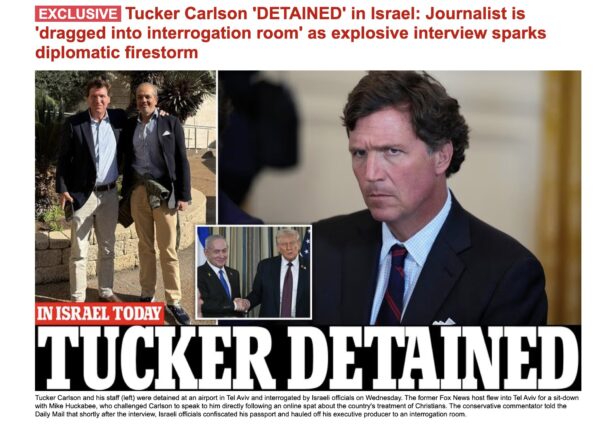
This interview took place just days after Tucker was detained by Israeli security after interviewing the US Ambassador Mike Huckabee which appeared in western media on the 18th of February 2026, a full week before trump launched the war.
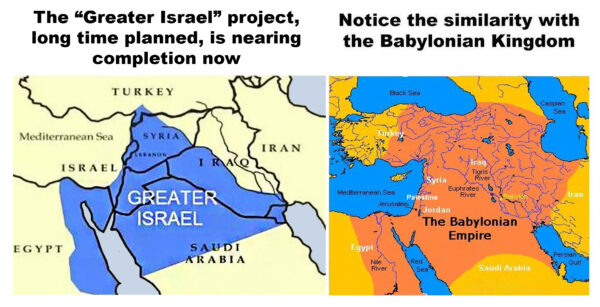
In this interview Carlson specifically mentioned to Trump those countries Israel is not yet occupying that will make part of the “Greater Israel Project”; Saudi Arabia, Jordan and Syria.
The concept of the “Greater Israel Project” (also known simply as Greater Israel or Eretz Yisrael HaShlema) is a controversial ideological and political vision rooted in certain interpretations of Zionism and biblical texts. It envisions an expanded Jewish state beyond Israel’s current internationally recognized borders, often justified by religious or historical claims. This idea has been associated with ultra-nationalist and religious Zionist factions in Israel, and it has been referenced by figures like Theodor Herzl in the late 19th century and more recently by Israeli politicians such as Benjamin Netanyahu and Bezalel Smotrich. Critics often view it as an expansionist agenda or even a conspiracy theory, while proponents frame it as fulfilling divine promises.
- Western Boundary: The “River of Egypt” (sometimes interpreted as the Nile River in Egypt or the more modest Wadi el-Arish in the Sinai Peninsula), extending into parts of Egypt including the Sinai.
- Eastern Boundary: The Euphrates River, reaching into western Iraq and encompassing parts of Jordan and Syria.
- Northern Boundary: Often up to the Litani River in Lebanon or Mount Hermon, including all of Lebanon and significant portions of Syria (e.g., up to Damascus and the Golan Heights).
- Southern Boundary: Extending to the Red Sea or Gulf of Aqaba, incorporating parts of Saudi Arabia (such as the Hejaz region) and potentially northern Egypt.
Detractors of the Greater Israel Project note the comparisons with the Babylonian empire.
Trump knows Iran’s innocent! In this interview Carlson states:
“But then I said, this war is not about Iran’s nuclear program, which you told me and the world that you eliminated back in last summer, in June.
“This war is being pushed by Israel with three aims. One, its own regional hegemony, take Iran off the map. You can’t– they don’t have freedom of movement as long as Iran is a regional power. Two, diminishing the power of the GCC, the six Gulf states, which are rival to Israel and are becoming this kind of Switzerland of the Middle East, and that’s bad for Israeli interests. And three, getting the US out of the Middle East because we constrain their ambitions. Getting our bases out, destroying our bases. Israel wants our bases out of the Middle East. I said that to Trump, to his face, in the Oval Office, days before the war began. And he looked at me and said, yes, you’re right. But in the end, we all die anyway, so it doesn’t matter. That’s exactly what he said. In the end, we all die anyway. And I said to him, shocked, But what about our kids, and our grandkids, and our country? And he goes, ugh! ”
Trump knows Iran’s innocent!
The full transcript of the 54 minute interview from NPR is below: 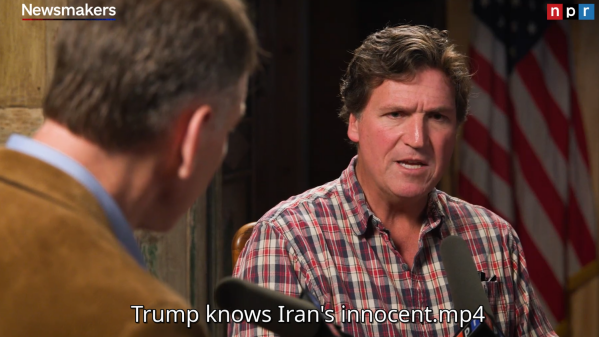
TUCKER CARLSON: He should have been removed from office immediately when he threatened nuclear war, threatening the offensive use of nuclear weapons, which is to say threatening the destruction of humanity. I said to Trump, you know, four days before the war started, if you do this, you know, the United States will be kicked out of the Gulf. Your legacy will be destroyed, along with party. I said this to Trump, to his face in the Oval Office. And he looked at me and said, yes, you’re right. But in the end, we all die anyway, so it doesn’t matter. That’s exactly what he said. In the end, we all die anyway.
[MUSIC PLAYING]
STEVE INSKEEP: This is Newsmakers, NPR’S biggest interviews. I’m Steve Inskeep. We question some of the most influential people of our time. New episodes drop whenever they’re available, and the best way to stay caught up is to follow or subscribe to this show on Spotify, YouTube, or wherever you watch or listen. You can also find us in the NPR app. Tucker Carlson has commanded an audience for decades as a cable TV pundit, as a Fox News star, and then after his firing, as the head of an independent network frequently broadcasting from this barn in Maine. In 2024, Carlson spoke for President Trump’s election. In 2026, he’s turned against the president over the Iran war and more. And that was the starting point for our discussion. Tucker Carlson, thanks for welcoming us here.
CARLSON: Oh, gosh.
INSKEEP: This is amazing. I have a lot of questions.
CARLSON: Oh, my. Well, I have a lot of answers.
INSKEEP: I want to talk about the economy. I want to ask about faith. I want to ask about AI. I need to begin with the news that you made in recent months, your break, if that’s the right word, with President Trump. I have a specific simple question about that.
CARLSON: Yes, OK.
INSKEEP: You have said that the president, in deciding to go to war with Iran, was more a hostage than a decision maker, a slave to foreign interests, and it was the single most foolish thing a president has ever done. Given that, should President Trump be impeached for going to war with Iran?
CARLSON: Well, let me just say, you know, it’s– it’s always a painful experience to hear your own quotes read back to you because often they don’t hold up. Many of mine haven’t. Many of mine haven’t. Those have. That’s– all three of those observations are true. And I think they’ve been proved true since I said them. He was pushed by a foreign country to do this. It is the most profoundly destructive thing any– any single decision a president has made in our history. I feel sorry for him. I’m not angry at him personally. I don’t think that he had the latitude to make this decision on his own. So, you know, I have pity. Should he be impeached? He– I mean, he’s not going to be– he’s not going to be removed for this because both parties agree with it. And that’s kind of the point. I think the Democratic leadership probably is an elaborate critique of how he’s prosecuted the war. But Chuck Schumer was, of course, always for a regime change war against Iran. So that is kind of the point. Trump joined the other side in the uniparty to do this. So he’s not going to be punished for it. They’ll get him on corruption or whatever.
INSKEEP: That’s a bit of an evasion, though, respectfully, in saying, well, it’s never going to happen.
CARLSON: Should he be punished?
INSKEEP: Should– should he be removed from office if you believe, as you’ve said, that he effectively betrayed the country?
CARLSON: He should be removed– he should have been removed from office immediately when he threatened nuclear war, threatening the offensive use of nuclear weapons, which is to say threatening the destruction of humanity.
INSKEEP: OK, what about the war in Iran then?
CARLSON: It’s enough for me to say he should be removed from office. He should have been removed from office by his own cabinet secretaries the moment he threatened a nuclear attack.
INSKEEP: You’re talking now about 25th Amendment, where a majority of the cabinet–
CARLSON: That’s correct.
INSKEEP: Yeah.
CARLSON: He should have been bundled up and taken out. That is a crime. There’s no greater crime than that. You think of all the know who go to jail for violating FARA or cheating on their taxes. Here, you have a guy threatening to eliminate the human race. And that’s not considered a crime? It tells you how deranged our moral scale has become. So he should be removed from office for threatening first-use nuclear strike.
INSKEEP: Thomas Massie, representative from Kentucky, as we’re speaking, a few days ago, introduced a resolution to impeach the Secretary of Defense, or Secretary of War, if you like, Pete Hegseth. The House seems to have adjourned to get out of that for the moment. What do you make of that?
CARLSON: I mean, again, we’re– I disagree profoundly with almost everything the secretary– and I’m going to call him the secretary of defense because I don’t acknowledge that a decent country would have a secretary of war. The purpose of the military is to defend the country. It’s not to, you know, instigate wars of choice. But I disagree with virtually everything the secretary of defense has said over the past nine months. But once again, that’s punishing a subordinate for decisions made above him. And I think that the purpose of leadership, of course, is to– fundamentally is to defend the people you lead and to take responsibility for failures when they occur.
[MUSIC PLAYING]
INSKEEP: I want to come back premise about the war in Iran, that Israel caused the president to do this, if I may summarize.
CARLSON: Not a premise. It’s an observation.
INSKEEP: OK. Is Israel still calling the shots? Shortly before this conversation, the United States confirmed an arms sale to the Israelis, billions of dollars’ worth of 2,000-pound bombs.
CARLSON: It’s not an arms sale. It’s a gift of 40,000 2,000-pound bombs. So the scale of that is hard for the modern mind to comprehend. But that’s, you know, six times the destructive force of Little Boy, the atomic bomb dropped on Hiroshima in August of ’45, six times. So it’s– it’s kind of hard even to understand how much that is. And the Israelis are not buying this, of course. They were given the money appropriated by Congress to the executive in order to purchase these. So they’re getting these for free, at a time when the US military is so short of munitions that were constrained, completely constrained, because we don’t have enough munitions. So what does that tell you? And by the way, the committees that approved this, which would be the House and Senate Foreign Relations Committees, the chairman and ranking in both, so the four people making this decision in the Congress are all four recipients of huge amounts of Israeli lobby money. And the Republican chairman, Brian Mast of Florida, served, volunteered with the IDF, and then showed up in the House of Representatives wearing an IDF uniform, a foreign military uniform. That’s the chairman of the committee that signed off on this decision. Where did this– where did this idea come from? It came from the US Embassy in Jerusalem. Who’s the ambassador? Mike Huckabee, completely an extremist and a committed Christian Zionist. His deputy, who runs the embassy, is the stepson of Mark Levin. It’s like you couldn’t make this up. None of this is an antisemitic conspiracy theory. There’s nothing antisemitic about it. It is– what you’re seeing now revealed is the control of what was supposed to be the most powerful country in the world by a country of 9 million people with no resources. So it’s a bewildering thing to see out loud, and it is out in the open. And there’s an attempt to rewrite history– reality in real time and deny that any of it’s true. But it is true.
INSKEEP: Let me push back on a couple of elements there. You mentioned a uniparty.
CARLSON: Yeah.
INSKEEP: Feeling that the parties are on the same page.
CARLSON: Yes.
INSKEEP: It seems to me that regarding war with Iran, that is demonstrably not true. Obviously, there are a lot of Democrats who support Israel and Israel’s point of view. And yet the last two Democratic presidents made a nuclear deal with Iran and then tried to remake a nuclear deal with Iran rather than launching a regime change war against Iran. It just doesn’t seem like a true statement–
CARLSON: Which is a huge improvement over what Trump did. I will say that.
INSKEEP: OK.
CARLSON: As someone who opposed Obama, especially in his second term, it took, I thought, courage and a huge amount of effort to get that nuclear deal done. And he should get credit for it. And I would– and I’m giving it to him. However, the last two administrations, Democratic administrations, Biden and Obama, were committed to an anti-Iran policy, which was expressed through sanctions, very aggressive sanctions, which didn’t work in any sense and–
INSKEEP: Except to get to the nuclear deal, ultimately. But go on.
CARLSON: Yeah, I guess. But did it– I mean, like, what did they achieve in the end? Kind of like– I guess the point is–
INSKEEP: And the agreement.
CARLSON: The– of course, but the orientation itself is what got us to this war. And the orientation was this, Iran is America’s greatest enemy. Well, on the basis of what are we saying that? The whole– the way we looked at it was– was in reference to Iran’s relationship with Israel. Iran’s hostile to Israel. Therefore, it’s our enemy. I just reject that. We should assess our relationship with countries on the basis of their relationship with us.
INSKEEP: What is Iran? What if Iran is not the enemy of the United States, which is a thing that the previous supreme leader and the current one would say they are? What are they?
CARLSON: Well, of course, they’re an enemy of the United States. But do they need to be? So what is Iran? Iran is a regional power. Why is Iran a regional power? Not because of its nuclear program or its drone or missile arsenal, but because of its geography. Iran has the longest coastline along the other side of the Persian Gulf.
INSKEEP: Yeah.
CARLSON: And the longest coastline along the now-famous Strait of Hormuz. So Iran is a regional power. It’s always going to be a regional power. It’s also the world’s oldest civilization. So you just have to deal with that. You can’t– the idea that you’re going to break up Iran and cause a permanent civil war there simply so Israel can have regional hegemony, A, I don’t think it’s possible. B, I don’t see how that serves our interests. It clearly it doesn’t. But I would say point about the Democrats and Iran and the Iran war, you’re absolutely right that previous presidents, including Republican presidents, resisted pressure from Israel to do what Trump did. So they get credit for that, for sure. But once the war broke out, the first thing I noticed was the absence of anti-war protests. As someone who’s been to an awful lot of them, as a lifelong resident of Washington, DC, I’ve been to a lot of anti-war protests, including immediately after we rolled into Iraq in March of 2003, there were anti-war protests.
INSKEEP: Six-figure protests, hundreds of thousands of people. Sure, go on.
CARLSON: There’s not one. So right after this war began, you had the No Kings protest.
INSKEEP: Yeah.
CARLSON: And those were, you know, anti-Trump or whatever. There was– like, where do those protests come from? Well, of course, they’re organized by the Democratic Party through its nonprofit proxies and donors. And they didn’t choose to use those protests to say anything really about the biggest thing that’s happened in my lifetime, which was the initiation of a regime change war in Iran. Why? Because they’re for it. That’s why.
INSKEEP: Do you think it’s that they were more concerned about what they would describe as the regime in the United States? Maybe they had other things on their mind.
CARLSON: Well, but they’re concerned about the regime in the United States because they say it does crazy things. Well, the craziest thing that’s ever done is start a regime change war in Iran. But they didn’t mention that? And they didn’t mention it because they’re for it. And Chuck Schumer, who was the leader of the Senate, Democratic Leader of the Senate, has talked about this 30 years. Iran is the problem. Its leaders are terrorists. We got to do something about them. We need regime change there. We need to fund the opposition to– within Iran to topple the government. I mean, it’s of a piece with everything Marco Rubio believes. So that’s what I mean about the uniparty. Of course, there are differences between the parties. But on the questions that determine the course of a nation that define history, which are economic policy– what’s your tax code look like– and your foreign policy– who do you bomb, and why– they’re in almost strict alignment. So I have heard people say that usually on the left-wing fringes for 30 years and always kind of dismissed them as crazy, the Noam Chomsky critique. And there’s a lot about Noam Chomsky that’s fake and I don’t like, but that critique is true. And I wasn’t able to see it because I was caught in the partisan lie. I was mesmerized by, and I was part of, by the way, the machinery of this as a cable news host for 29 years. I was part of this– effectively a deception where the parties, you know, disagree on an issue, trans rights, amnesty, which are inherent. They’re real issues. I’m not saying they have no meaning.
INSKEEP: You’ve talked about them on camera so far.
CARLSON: I’ve talked about them extensively.
INSKEEP: Yeah.
CARLSON: In fact, I’ve talked about them way too much and sort of missed the fact that, I don’t know, we still tax income at almost twice the rate of investing, that labor at twice the rate of capital. It’s like–
INSKEEP: The capital gains tax versus the income tax.
CARLSON: Yeah. I mean, that’s kind of the biggest fact of our tax code. And I don’t think I’ve ever done a debate on that. Maybe one.
INSKEEP: I want to follow up on something else you said. You said you’re not being antisemitic to criticize Israel in this way.
CARLSON: Right.
INSKEEP: I want you to have an opportunity to address this directly. I think you understand– I assume you understand, when you start talking about people with dual loyalty and strange connections to Israel, who are also in the government, and a uniparty that is taking orders from outside, people who are antisemitic are liable to hear certain things in that. What do you make of that? What do you make of the–
CARLSON: People who are antisemitic are liable to– I don’t really know anybody who’s antisemitic, for one thing.
INSKEEP: OK.
CARLSON: So I can’t confirm that.
INSKEEP: You would agree that there have been antisemites?
CARLSON: Of course.
INSKEEP: OK, go on, go on.
CARLSON: You know, people– there’s a lot of tribalism in this world.
INSKEEP: True.
CARLSON: And now more than ever. And I– and I detest it. And I fear it and worry about it a lot.
INSKEEP: But you’re a thoughtful guy. Do you ever wonder, wow, maybe that’s me? Or maybe I’m having that effect or giving that impression, even if I don’t mean it?
CARLSON: I think that we haven’t had this conversation for 60 years because people are afraid of being called a bigot for noticing something that has nothing to do with ethnicity. And I just refuse to participate in that because the stakes are now too high. And so for decades, I, of course, noticed the undue influence of Israel as expressed through its lobby in Washington, which I was very familiar with, since I lived there and knew people in the Israeli lobby and, by the way, like them, for whatever it’s worth, personally. But I decided I’m not going to weigh in on that because I have all kinds of other concerns. I– you know, I– Of course, I’m not antisemitic in any sense. But I don’t want to be called that, and I don’t want to upset people. And I sort of stuck with that up until the push for war with Iran, at which point, I thought, this will destroy the United States. This will result in the deaths of millions of people. This is the worst thing I can imagine. And so I don’t really have a choice. And by that point, I was in my mid-50s, and my children were grown. And I didn’t have a normal– I didn’t have a job anymore because I’d been fired so many times. I worked for myself, and I thought, I’m in this weird, almost unique position where there’s kind of no downside for me. I can– I can take the lumps, and I have. But as to whether it’s, strictly speaking, antisemitic to criticize the behavior of a secular foreign government, I mean, it goes without saying that no. In fact, that accusation is not only baseless. It’s crazy. And I almost don’t want to dignify it even by responding to it. But since you asked, let me just say that the majority of American Jews, when polled, are not for Netanyahu. So not that I need to appeal to that. I’m just going to appeal instead to reason, but it’s just factually true. And there’s– Netanyahu’s claim, which is specious and totally dishonorable, is that when you criticize me, you criticize global Jewry. You criticize all Jews. And it’s sort of not my job to defend all Jews. As an Episcopalian, I’m not even– it’s not my fight. But I feel somebody should stand up and say, that’s an outrageous thing to say. Who gave Benjamin Netanyahu, who’s some sleazy day-trader politician with a murderous history, whose government has murdered 20,000 children, who gave that guy the right to speak for an entire group?
INSKEEP: We could have a whole discussion about this.
CARLSON: Yeah.
INSKEEP: But let me refocus for a moment on the administration.
CARLSON: Yeah.
INSKEEP: Do you include Vice President Vance in your critique of the administration?
CARLSON: Well, it depends what critique.
INSKEEP: You’re just talking about going to war.
CARLSON: Well, I don’t think the vice president was going to war. I think it’s pretty obvious. I mean, he’d spent his entire relatively short but well-publicized political career arguing against a war like this. And it was–
INSKEEP: And he was to be against. But publicly, he’s done his job and supported the president.
CARLSON: Yeah, I mean, I think that– well, let me just say point-blank that I not only know the vice president, but I’ve been pretty good friends with him. I don’t think I’ve ever been friends with a politician before. I don’t think I ever will be again. But I am friends with JD Vance because I think he is a genuinely decent person, smart, thoughtful, self-aware, loves his family, has a wonderful family. So there’s so much about him I like. I’ve considered him a friend since before he went into politics, which puts me in a little bit of an awkward position. But it also puts me in a position of, like, some knowledge of what he thinks. But everyone who’s paid attention to him knows what he thought. And it’s– I don’t almost ever vote for anybody, but I voted for Donald Trump this time in part, heavily in part, because JD Vance was his running mate. And JD Vance, his views on foreign policy are squarely in the center of where most Americans are. You know, like, hey, let’s not have another insane, counterproductive, deadly, expensive Middle East war on behalf of Israel. That was his position. And– and yet we did. And so that happened without his encouragement. He clearly sees his job primarily as backstopping the president, supporting the president, displaying public loyalty to the president. Most vice presidents have felt that way. But, you know, so I grieve for the position that he’s in. And I say that with deep affection for him, which I still have.
INSKEEP: Have you urged him to speak out?
CARLSON: You know, my friendship with JD Vance has been used, really, since the moment he was chosen to undermine him. This is an intra-Republican Party struggle that I assume most NPR viewers are not that familiar with, or listeners, but–
INSKEEP: But we could have a discussion about the NPR audience. But please–
CARLSON: No, no, no, no, I’m not attacking the NPR audience. I’m just saying, in case, you don’t follow Republican politics closely–
INSKEEP: I got you. I got you.
CARLSON: –you may not know that the battle is between the neoconservatives, who define the Bush administration, for example, got us into the Iraq War, and people who learned something from the Iraq War, often called the realists. And JD Vance was– was very much on the latter side, on the realist side. And that was overwhelmingly important to me, that the Republican Party change from being a tool of a foreign country to being an instrument of uplift for the United States.
INSKEEP: So–
CARLSON: It didn’t happen.
INSKEEP: OK.
CARLSON: And I– nothing has ever made me sadder. And it brings me no pleasure to be vindicated in my predictions. And I said to Trump, you know, four days before the war started, if you do this, you know, the United States will be kicked out of the Gulf. The American Empire will begin to collapse. Your legacy will be destroyed, along with party. And a lot of people are going to die.
INSKEEP: But getting back to that question, have you urged the vice president to speak out in some way?
CARLSON: I mean, I’m not going to– no one is listening to me, obviously. So I would say– I would urge not simply– well, let me do it now. I would urge not simply the vice president, but every member of the cabinet, everyone who works for the president to march into his office and demand that he renounce his statements calling for the use or threatening the use of nuclear weapons. And– and if he doesn’t do that, he should quit. That’s what I think.
INSKEEP: If you’re concerned about foreign influence, which is what we’re talking about, foreign government influencing the United States, are you also concerned about foreign influence on the United States through the president’s dealings and his family’s business dealings.
CARLSON: Well, there’s a lot of foreign money sloshing around, that’s for sure.
INSKEEP: Mhm.
CARLSON: What’s the effect? I mean, if Russian businessmen could pay the Trump family and push Trump through those payments to end the war in Ukraine, I would be for it. The main problem is, I explained a moment ago, with Israeli influence over the US government, is that it leads to the destruction of the US and American interests. So we have an overriding interest in seeing a negotiated settlement to these two wars. And if we don’t, we will be destroyed. It’s that simple. So my orientation is always, you know, because I live here and my kids live here, what’s good for the United States? We need to get the war in Ukraine. We need to stop prosecuting a war against Russia, which is what we’re doing right now.
INSKEEP: But you focus on Israel. The president and his family have business relations with people throughout the Middle East, in other countries affected by this war, through–
CARLSON: For sure.
INSKEEP: –the cryptocurrency enterprises.
CARLSON: Oh, extensive, extensive– Well, the Qataris gave Trump a plane.
INSKEEP: There you go.
CARLSON: Of course. And what did it get them? It got them. The United States did not defend Qatar. The United States moved THAAD batteries from the Gulf to Israel. And of course, Israel has given us nothing, only taken $350 billion total since 1951. So, I mean, it was a bad bet, you know? And of course, if your point is it’s corrupt to take foreign money, yeah, I agree. I’ve never taken a dollar from any foreign–
INSKEEP: Also, my question is whether that would be a–
CARLSON: Well, they didn’t get anything
INSKEEP: –source of influence?
CARLSON: They didn’t get– Well, it wasn’t a source of influence because when Iranian drones and missiles poured into the Gulf, into Abu Dhabi, Dubai, Riyadh, American bases, all the way in Jordan and then into Qatar, the United States didn’t do anything about it. In fact, last week, the Saudis were routed in Yemen, thereby giving the Houthis control over the entrance to the Red Sea, and Mohammed bin Salman, the Crown Prince of Saudi, apparently called Trump twice and said, help us, and he didn’t. So what did their investment, what did the billions they gave Jared Kushner, get them in the end? A middle finger.
INSKEEP: But let me ask one counterquestion about the president’s motives. Your idea is he was told to go to war by someone and did it almost against his will. I’m thinking it’s called Occam’s razor, the idea that the most likely explanation for something is the simplest.
CARLSON: Yeah.
INSKEEP: Would a simpler explanation be, the president has no idea about foreign affairs, doesn’t listen to people and made a mistake?
CARLSON: Well, that’s not likely in his case, because it’s not true. And I’m not guessing about this, I was there. I mean, I spoke to Trump at least 10 times in the month of February, probably more in the month of January. I visited almost every single– Except for Iran, I visited every country now involved in this war in the month before the war. So– because I knew it was coming, and I had known that since February 4 of 2025, when Benjamin Netanyahu showed up as the first visitor to the White House, and I knew exactly why he was there. And, of course, I heard from people in the meeting why he was there. He was there to push the war we’re currently in. So I knew that Trump was under immense pressure, and therefore, beginning then, I talked to him about it, you know, for a full year. And he was not only aware of the risks, he understood them. And he understood them because they’re so obvious, but they also are exactly the kind of thing that Trump understands. Commodities prices, for example, which don’t tell the whole story about anything, but they are the basis, really, of any economy, the price of commodities. And Trump follows them closely. And the commodity he follows most closely, of course, is energy. It’s oil and gas. And he’s really interested in the topic. He talks about it constantly. And he understood that this entire, the pivotal oil and gas region in the world, could be shut down very quickly once this war begin. He understood that. We talked about it at length, and he didn’t want to do it. He also talked about, beginning in 2003, the foolishness of fighting a war across the world whose aims are unclear. In other words, the Iraq War, which he was offended by instantly, to his great credit. He knew that, that’s the destruction of a president. I mean, he once said to me, when George W. Bush took office, he had all these plans. Among them, reforming Social Security, charitable choice. I mean, you sort of go back to his inaugural, a land war with Iraq was not on the list. And yet, of course, it defined his presidency and will for all time, and destroyed his presidency and him as a man. Trump meditated on that for 20 years. And so the idea that Trump didn’t know the risks. And once again, I’m in an unusual position because I talk to Trump.
INSKEEP: But you’ve quoted him as waving off the risk by saying, it’ll all be fine, which could–
CARLSON: You want to know what he said?
INSKEEP: Go ahead.
CARLSON: I’ll tell you exactly what he said.
INSKEEP: Please.
CARLSON: And I haven’t said this, but I’m just going to tell you.
INSKEEP: Sure.
CARLSON: And this is a fact. And I can look at my calendar, but it was in– it was– I had flown back from Tel Aviv, from Ben-Gurion Airport after seeing the ambassador. And two days later, I was in the Oval with Trump, alone. And he was annoyed that I had given Huckabee a hard time when this whole conversation about Huckabee. And I said, here, as the son of an ambassador, I know what the job entails. And your ambassador, your representative to this nation, just called for rearranging the Middle East and allowing Israel to take parts of Saudi Arabia, Jordan, and Syria. Like, this is a diplomatic incident. And so we had this whole conversation about this. But then I said, this war is not about Iran’s nuclear program, which you told me and the world that you eliminated back in last summer, in June.
INSKEEP: Yeah.
CARLSON: This war is being pushed by Israel with three aims. One, its own regional hegemony, take Iran off the map. You can’t– they don’t have freedom of movement as long as Iran is a regional power. Two, diminishing the power of the GCC, the six Gulf states, which are rival to Israel and are becoming this kind of Switzerland of the Middle East, and that’s bad for Israeli interests. And three, getting the US out of the Middle East because we constrain their ambitions. Getting our bases out, destroying our bases. Israel wants our bases out of the Middle East. I said that to Trump, to his face, in the Oval Office, days before the war began. And he looked at me and said, yes, you’re right. But in the end, we all die anyway, so it doesn’t matter. That’s exactly what he said. In the end, we all die anyway. And I said to him, shocked, But what about our kids, and our grandkids, and our country? And he goes, ugh! That’s–
INSKEEP: What does that mean?
CARLSON: I don’t know. He didn’t respond. That’s a verbatim exchange. And I said– and– and as God watches, I said that.
INSKEEP: OK.
CARLSON: And think it was– I thought it was true then, and I think it’s been proven true now. The goal was to get the US out, to diminish the GCC, and, obviously, to take Iran off the map and sink it into permanent internal strife, into civil war, sectarian strife. And he said, it doesn’t matter because in the end, we’re all dead anyway. And I was shocked by that because that’s nihilism, and that’s the last thing any leader should display or any person should display. It does matter. Who lives or dies does matter. The future does matter. I believe that. I have four children.
INSKEEP: You believe him to have agreed with your idea–
CARLSON: Of course.
INSKEEP: –that Israel was pushing against American interests specifically?
CARLSON: Look, here’s what I said, and this is the truth. We don’t consider anything in foreign affairs ever from the perspective of other nations because we have been in this position for so long that it doesn’t matter. We’re exceptional, and people do what we say. But in order to understand why people do what they do, you do have to look at things from their perspective. So I was taking what I think is a charitable position toward Israel, actually. Israel has nuclear weapons. Israel is a legitimate global power because of that. And so from Israel’s perspective, Israel wants to control its region. Why wouldn’t they? We’ve got the Monroe Doctrine because we want to control ours. We had the Cuban Missile Crisis for the same reason. Obviously, China is inflamed by American troops in Japan for the same reason. Same with Taiwan. China wants control of the South China Sea, wants control of the East. Why shouldn’t it have that? Russia was provoked into war over Ukraine for the same reason. Russia wants to control Belarus for the same reason. Control is not the same as enslave, but you want control over region. You don’t want your enemies at doorstep. Every great power feels this way and always has and always will. This is what I said to Trump. And so from Israel’s perspective, what are the barriers to regional control, full regional control? Like, elbow room. I don’t want to get hassled over Southern Lebanon or Gaza. Who’s hassling us? Well, the GCC is hassling us. Iran is hassling us, and the United States is hassling us. And I didn’t present it as Israel wants to kill people. I was just like, Israel is a nuclear armed power. So of course they want control of the Middle East. Why wouldn’t they? And what’s standing in the way? That’s exactly what I said. And I think that’s true. And I just want the record to reflect that I am giving Israel grace in this. Israel has the same motives that any power does, including us.
INSKEEP: Has your concern about the president reached the point where you would advocate for people in this year’s elections, which are pretty important, to vote for Democrats, who say they want to put a check on the president?
CARLSON: I mean, you would like– I don’t want anyone to vote for this. You have, like, Fox News politics and unhappy-rich-girl politics. Those are options. You’ve got one party that’s like, oh, we need to ban Sharia law and kill more Muslims. And you’ve got another party that’s just like the politics of Jackson Hole. You know what I mean? It’s like, unhappy, inherited money, rich girl. Trans people, ICE is bad. It’s like, how about we get an adult party here?
INSKEEP: When you have talked recently about finding some third way, is that a wish or a plan?
CARLSON: Well, I don’t think I could organize your daughter’s birthday party. I mean, I’m just lacking the skills required to mount–
INSKEEP: She prefers a small one. I think you can. Do it, yeah.
CARLSON: If it’s the three of us at The Palm for dinner, I can do it.
INSKEEP: OK. Got it, got it.
CARLSON: But anything beyond that, out of my capacity. I don’t have the skills for that. My skills are rhetorical, I think. My self-assessment is, I think I can understand big-picture trends, and I think I can explain them in a way that’s understandable. That’s kind of it.
INSKEEP: Mm-hmm.
CARLSON: So I wouldn’t even attempt to organize anything, ever. What I can do is what I do do, which is try to identify the problem, speak the truth out loud. That’s the beginning of all change, positive change. And the core problem is that no matter who you vote for, you get John McCain. And most Americans don’t want John McCain. Nothing against John McCain personally, whom I knew very well and liked, but his views are totally out of the mainstream, completely out of the mainstream. So we just need a leadership that represents the majority of the population. It’s kind of that simple in its priorities.
INSKEEP: Are you going to vote this fall?
CARLSON: No. As I said, I almost never vote, just because of the weirdness of my job. Not because I– I’m against the Democratic system. It’s our only hope because after that comes violence, of course.
INSKEEP: Your neighbors here in Maine have an opportunity to decide control of the US Senate. They’ve got a Senate race that means a lot. What would you tell them to do or think about or consider?
CARLSON: Well, they have less of a choice than they did. They had a choice between Susan Collins and Graham Platner. I’m not really on either side, actually. I know them both and, you know, kind of like them both. I’ll just say that, Though I think it’s illegal to like Graham Platner. But I do as a person. But Graham Platner was slightly different from your conventional Democratic in that his foreign policy views, which he earned by serving multiple tours in Iraq and almost getting killed, he has a right to those views. His views were out of the Democratic mainstream, and he was destroyed by the Democratic Party in a fake sex scandal.
INSKEEP: So Graham Platner should still be the Democratic nominee?
CARLSON: Of course. Graham Platner was– By the way, Graham Platner was the choice of voters. Remember them in Maine? He won. He won. So, yeah, he was the overwhelming choice. But, of course, they don’t get to vote for him in the fall because the Democratic Party, including the Democratic Party of Maine, which is run who aren’t even from Maine, rich girls not from Maine. Literally, rich girls not from Maine. I hope everyone’s offended by that because it’s true. Yeah, they took him out. They took him out in a fake sex scandal. So, my view, I’m not here to endorse Graham Platner. I’m not endorsing Graham Platner. I’m not voting in– you know, I’m not voting at all. However, I’m endorsing the idea that voters ought to have a real choice. Not between, you know, two species of the same flavor but between flavors that they choose themselves.
INSKEEP: Do you not care at all who controls the Senate or the House next year?
CARLSON: Of course I do. I just think there’s less of a difference than I thought there was. And for me, as someone who was involved in partisan arguing for 29 years, I can promise you, it’s a bewildering realization, one I did not want to have, because what does it say about how I spent my life?
INSKEEP: What does it say about how you spent your life?
CARLSON: Well, a lot of it was wasted because I was having fake debates, and I’m not exactly sure why I didn’t see that or allow myself to see it. Maybe because I was at the center of it. And there’s a famous quote, which I’m going to mangle, so I’m not going to attempt it. But basically, the idea is, if you’re paid not to notice something, you don’t. And I think that may have happened to me, and I’m ashamed to say that. I don’t actually know why I couldn’t see some of this. But I couldn’t, and now I can, and I’m shocked by it. I’m absolutely shocked by it, so.
INSKEEP: Let me ask you about another aspect of this presidency that you’ve commented on recently. There’s a Vanity Fair article that quotes you describing a meeting with the president in which the Epstein files came up.
CARLSON: Yeah.
INSKEEP: And you got from the president an explanation of why he was so reluctant to release them.
CARLSON: I remember the conversation very, very well. So I knew, you know, a million people in that world because of my age and my job. And I knew a million people who’d eaten with Epstein. I knew people who knew Epstein very well. I knew people who worked for Epstein. Like, Epstein was not only, like, a world-famous criminal/intel operative. He was also someone who circulated in the world that I lived in. I never met Epstein, thank God, but I knew a million people who knew him. So I knew a lot about the story, and I thought it was really interesting and dark. So when this all came to a head last summer– I think it was in July– and it became clear that Trump didn’t want to release the files that the DOJ was holding, I said to Trump, dude, you know, what are you doing? I don’t think that this implicates you. I have never thought, and I don’t think to this day, that there is some hidden sex crime that Trump committed. For all my criticisms of Trump, I don’t think he molested girls on Epstein Island. I just don’t think that. I mean, my view will change if evidence emerges, but I didn’t think that then. I don’t think it now.
INSKEEP: You don’t think there’s a deep secret in the Epstein files that we don’t yet know?
CARLSON: I do think.
INSKEEP: President Trump, I mean, specifically. No, go on. You tell me what you think.
CARLSON: Well, I think a lot of things. But anyway, at the time I thought– but I don’t think it’s sex-related, and I didn’t think that then. So I said, why don’t you just release all the files? You said you would, and I don’t think it’s going to hurt you. And he said, oh, this is all a plot to discredit me. It’s like Russiagate, which was a plot to discredit him, and totally absurd, actually. And I often said that on Fox, and I mean it, and it turned out to be true. It was absurd. So he said, well, it’s like that. And I said, no, it’s not like that at all. Like, you just release it. Like, why do you care? And he was upset about it and, like, paranoid about it. And– And of course, we saw what happened next, which is he wound up taking for Epstein’s crimes. Why would you do that? Being blamed for Epstein’s crimes.
INSKEEP: So he was withholding the evidence because he thought it would be used against him?
CARLSON: He thought the whole– Well, look, I don’t know what he actually thought. I just tell you what he told me.
INSKEEP: He said, yes.
CARLSON: Yes. He said to me, the whole conversation will be twisted by the media to implicate me in what Epstein did. I got nothing to do with this. I broke off with my friendship with him many years ago after he hit on girls at the spa at Mar-a-Lago. That’s what he told me. The guy was a creep. I didn’t like him, and I’ve got nothing to do with this. And the more we talk about Epstein, the more the media will use it to implicate me in Epstein because I knew him.
[MUSIC PLAYING]
INSKEEP: I want to move on to another question, another aspect of the world, and in this case, the president, at least at the beginning. You said, I never believed Trump was a Christian. He has, in fact said, quote, “I am a Christian.” Why do you think he’s not?
CARLSON: I think he said, I’m not a Christian. He also said, I’m not going to heaven, twice.
INSKEEP: I want to ask about that too.
CARLSON: I don’t know the answer. You know, I– I don’t ever want to make judgments about other people’s religious faith. I respect religious faith, all faiths, through the course of my life reflexively defended faithful Muslims, Orthodox Jews, faithful Hindus, and faithful Christians. I just like people of faith. I like people who bow down before a higher power because I think it’s essential. As a prophylactic against hubris, if nothing else.
INSKEEP: Sure. Humility is good. Go on.
CARLSON: It’s essential. And in leadership, it’s the indispensable. Humility and courage are the two things you need, much more than intelligence. But anyway, so I feel uncomfortable declaring Trump’s, you know, a Christian or not or– But I believe he has said, I’m not a Christian.
INSKEEP: So you think he’s not a Christian because?
CARLSON: I shouldn’t say that. I mean, as a pretty bad Christian myself, it’s really not my job. In fact, I’m not allowed to run around judging other people’s spiritual condition. So to the extent– first of all, I’m sorry for saying that. And second, I said it on the basis of what I thought was a real quote on a video that I saw. I was not there. Christian said–
INSKEEP: OK.
CARLSON: He said, I wasn’t.
INSKEEP: There may well be such a quote. We’ll look it up.
CARLSON: Yeah.
INSKEEP: There’s another aspect to this, though. Let’s talk about something that he said. You correctly noted something the president said. In October 2025, the president told reporters, I don’t think I’m getting into heaven. He said it three times, three different ways. As someone who knows him, who’s had long conversations with him, why do you think he would not believe he’s getting into heaven?
CARLSON: Because I think he feels that way. I think he feels that. He fears it. I will also say that Trump drops a lot of self-aware comments parenthetically. You know, speaking to Trump is an amazing experience, and it’s so amusing and interesting. And it’s almost like being hit with a wave of warm water. You kind of lose orientation for a second. There’s just a lot, right? And part of it’s by design to throw you off balance and to subdue you with words.
INSKEEP: Mm-hmm.
CARLSON: Disconnect–
INSKEEP: To control the room, if you’re the one–
CARLSON: 100%. That’s exactly– And I know you’ve had the experience. So it’s– you know, it’s something that he does on purpose. It’s a tactic, but it’s also a tic. It’s something that just– he just does because that’s who he is. And one of the things that he does is, he throws these lines out that kind stick with you later. Did he say that? I mean, he once said to me in conversation– he said, I’m really insecure, which I’ve always known, of course, because I know him. And then he said it again, because I’m really insecure. And you sort of, is he joking? Is he not? No, he’s not joking. He tells the truth about how he feels in the middle of this kind of roiling bouillabaisse of words and ideas and grunts and inarticulately expressed concepts. He’ll throw out this thing that he’s thinking about. And I felt that his public declaration, I’m not getting into heaven, was– was real. I don’t know that. I’ve never asked him about it.
INSKEEP: Yeah.
CARLSON: But I think that’s right. I know that he’s uncomfortable with the idea of death, very, and– And that’s been a good thing, by the way. Trump, in his first term, didn’t get us into– By of American presidents, he was a restrained leader, very restrained, the most restrained since Jimmy Carter. And I love that about him. I love that then, and I’m grateful for it.
INSKEEP: Do you think that then that his genuine state of mind is, I think I’ve done some terrible things in the world, whyever I did them, I did them, and I don’t think I’m getting into heaven?
CARLSON: Well, I mean, I’ve been around a lot of– as we all have, at a certain age, been around people who are on their way out, who can see death approaching. And of course, these are the questions that they fixate on. It’s not, how am I going to make more money? You know, the temporal concerns tend to kind of fade as you have a sight picture of eternity.
INSKEEP: Although, he’s been making a lot of money. We’ll just– no.
CARLSON: Oh, he certainly has.
INSKEEP: OK, go on.
CARLSON: Which is disgusting. No president should ever make a dollar as president. That should be completely– I don’t know why that’s not illegal. I hope it is. No member of Congress should be using his office to make money. But anyway, but I do think people, as they age, all of a sudden, begin to think about the questions that American society discourages people from asking for most of our lives, which is like, what happens after? That’s natural. I think it’s important. And I’ve known other people who feel despondent as they approach the end, because they don’t have confidence that something better is coming for them. It’s totally– it’s the most– it’s the most understandable thing. But when he said to me, it doesn’t matter because in the end, we’re all dead, that suggested to me, someone who’s like, made decisions about what happens next. Like, I just don’t care at this point. Like, I’m– I’m just proceeding with the knowledge that blackness awaits. Boy, that is not a healthy worldview, and it’s an unacceptable worldview for a man with decision-making power.
INSKEEP: I have a question about your own faith.
CARLSON: Yeah?
INSKEEP: You described yourself as Episcopalian. You grew up that way? You grew up–
CARLSON: Oh yeah.
INSKEEP: You were raised Episcopalian? Has your faith–
CARLSON: See if that means anything. [LAUGHS]
INSKEEP: Well– it means a certain–
CARLSON: It’s a cultural designation, really.
INSKEEP: It’s a cultural– OK, that’s a fair point. And then–
CARLSON: Yeah, but I’m a generational Episcopalian.
INSKEEP: There’s religion, which is maybe different from someone’s faith.
CARLSON: Yeah, for sure.
INSKEEP: Has your faith evolved or changed in some way in recent years?
CARLSON: Oh, so dramatically. Yes, so dramatically. I mean, I wouldn’t hold myself out as a role model for anybody in any category ever, and particularly not with my faith. I don’t think I’m an especially good person. And in fact, if there’s one thing– I had a long conversation with one of my many daughters this morning on this exact topic that if there’s one thing that an attempt to follow Jesus inspires in all people who sincerely do, it’s like a deep knowledge of own inadequacy and crappiness as a person. So I mean, my– my personal view is that if you decide, like, I’m going to really try to be a good Christian and you start to believe that you really are a good Christian, you’re doing it wrong. Like, humility is the ticket price. Repentance is the first step. So–
INSKEEP: Is that the evolution for you, is realizing that in a deeper way than maybe 10 or 20 or 30 years ago?
CARLSON: Yeah. Oh, 100%. Yeah, I mean, I– It’s been a process. I had to quit drinking. I’m no longer allowed to drink, for 24 years. So, you know, when you– everyone else is drinking and you realize you can’t drink because you’re just like a slobbering, pathetic, incontinent alcoholic, like, that’s a– that’s a constant reminder that you’re not, like, a perfect person. [LAUGHS]
INSKEEP: Right.
CARLSON: Right?
INSKEEP: OK.
CARLSON: Which is nice. Which is why AA is so great better than any church I’ve ever been to. Because you can’t even talk until you admit, in public, your first name, not your last name. Like, they detach you from your family. So it’s just you. Hi, I’m Tucker, and I’m an alcoholic. Imagine saying something like that. It’s so embarrassing. An alcoholic, really? Like a spreading urine stain on Skid Row. It’s like– it’s, like, embarrassing. But you have to say that or you can’t talk. So there’s something about that that is– And this is, of course, by design, the people who wrote the 12 steps were Christians. But it very much identical to Christianity. Like, you don’t come before God in prayer before admitting, you know, forgive us our sins as we forgive those who sin against us. I’m no better than you. That’s, like, a basic Christian precept. And I love that. I love that. Like, it’s the greatest. I don’t know of another faith that demands that.
INSKEEP: There are people who imagine an impersonal God that created the world but is not talking to the individual, and there are people who feel they have a personal relationship with Jesus. Where are you on that?
CARLSON: Serious question?
INSKEEP: If you’re comfortable answering. If you’re uncomfortable–
CARLSON: Of course. Well, I’m the latter, of course. I mean, I have zero interest in a watchmaker God. Like, OK, how’s that different from the Big Bang?
INSKEEP: The watchmaker who makes the thing?
CARLSON: Yes.
INSKEEP: OK.
CARLSON: Sorry, sorry. Right.
INSKEEP: Yeah, exactly. Yeah.
CARLSON: Yeah. How is that different from the Big Bang? It’s not, in any way. No, no. You don’t– And by the way, I feel like, and this is self-flattery, but I feel like I’m kind of busy. I don’t have time for any of this stuff unless it’s real, unless it’s actual. Unless God is alive and showing his power every day through other people and in nature. I mean, I don’t have time for it.
INSKEEP: The conversation about artificial intelligence touches on God again and again.
CARLSON: Yeah.
INSKEEP: You hear about people who think they’re–
CARLSON: The sand god.
INSKEEP: –creating a new god, a sand god– silicon, interesting. You hear about people who think that by developing AI, they’ll get closer to God. They’ll get closer to the knowledge of how the universe works. What do you think about that line of reasoning?
CARLSON: You get closer to God through humility. You can’t approach God before you acknowledge you’re not God. OK? So anything that causes people to embrace the lie that they are godlike, that they’re not lumpy, furry, pathetic primates stumbling around in the dark, gets them farther from God. OK? So let’s just start there.
INSKEEP: OK.
CARLSON: And I think all, the three Abrahamic faiths acknowledge that. In fact, that’s core. It’s certainly core to Judaism, whose core texts are also the core Christian text. So I have read them a lot. And I think it’s true in Islam too. You bow down before God five times a day. So I would just say, again, you’re not getting close to God until you acknowledge you’re not God. And my sense is that a lot of the developers of AI mistake themselves for God. And I have interviewed a lot of them. I know a lot of them. I’ve spent a few years on this topic, both professionally. I’ve done a bunch of interviews on it. But more than that, I’ve traveled to a number of different countries and talked to a bunch of different people off camera because I’m really interested in it. And of course, I don’t understand it. But what I’m struck by is how little they understand about AI, the people who are developing it. And I mean the biggest companies. And then I’ve talked to all of them except–
INSKEEP: Even some of the engineers don’t get why things happen.
CARLSON: So they don’t understand two key things. I mean, I think they don’t understand a lot, but the two key things they don’t understand– and they’ll tell if you ask them. One is how the large language models work. They don’t understand. So their large language models are based on one paper that theorized, if you do this–
INSKEEP: Yeah.
CARLSON: –something wild will happen. And the paper was right. Something wild did happen. But if you ask any AI engineer, well, how exactly does that work? They can’t tell you because they don’t know. OK? And the second thing they don’t know is the energy draw. They don’t– nobody– as of yesterday, at least– understands exactly and can predict with precision how much energy AI compute will consume. They can’t scale it out.
INSKEEP: Yeah.
CARLSON: And so those are big unknowns, huge unknowns. Like, on the basis of those two facts alone– we don’t know these two things– we need to slow down. That’s my view, right there.
INSKEEP: You, for several years since leaving Fox News, have made living on the internet.
CARLSON: Yeah.
INSKEEP: And you’re a thoughtful guy.
CARLSON: But not in pornography. Like, totally legitimate.
INSKEEP: That’s good to know.
CARLSON: Yeah, yeah.
INSKEEP: Good to know.
CARLSON: Not the dark web, just the normal web.
INSKEEP: I am glad. Thank you. Thank you for confirming that. I appreciate– I appreciate it. You’ve made living on the internet. And I’m sure you’re very thoughtful and you understand the incentives, the incentives to get more views, to get more clicks, to build up the numbers. And the incentives seem to cause people to tend toward more extreme or divisive or wild statements. How do you guard against that danger yourself as you talk in front of people all the time? And do you think you’ve ever been affected by it?
CARLSON: Well, I’ve been in– in audience-incentivized media like you, like, my whole life. So cable news measures its audience response way–
INSKEEP: Sure, yeah.
CARLSON: –way more precisely. Yeah. And much more hangs on it, you know, because– So I’ve definitely lived– It’s not just the internet that’s like this. It’s The New York Times. It’s The Washington Post. It’s NPR. It’s–
INSKEEP: Circulation, audience.
CARLSON: –me. 100%.
INSKEEP: Yes, absolutely.
CARLSON: No one’s–
INSKEEP: But there’s something special about the internet, that instant feedback, success or failure.
CARLSON: I mean, I’ll give you an honest answer, which you won’t believe. But you can– I’ve got a couple, three people who work here, and you can ask them off camera.
INSKEEP: I’m not claiming to believe or disbelieve anything.
CARLSON: I don’t pay attention.
INSKEEP: You don’t pay attention?
CARLSON: I was the only anchor at Fox who was not on the ratings list. I never learned how to read ratings in television.
INSKEEP: The ratings list was like an–
CARLSON: Internal email, like every day. Well, I wasn’t on Fox email, so that was one. I don’t do email.
INSKEEP: Honestly, when you were on Fox, you didn’t need to keep track of your ratings. Everybody knew they were very high.
CARLSON: But my ratings were up because I didn’t pay any attention to them. And when I started at Fox, which was the week Trump got elected in 2016, I thought to myself, what do I want to do with this? I’ve been in television for 20 years, and I’ve had a lot of shows. And I thought, now I’m in prime time at Fox. Like, people watch. What do I want to achieve? And thing I wanted to achieve was get the neocons out of the Republican Party, because they did the Iraq war. And I was really mad, and I remain mad, about the Iraq war. And so I systematically brought on Fox contributors, like Max Boot or John Bolton, and I grilled them on my show, and the audience hated it. They hated it because a key plank of the Republican platform since George W. Bush was, we’re neocons. Like, we’re the world’s policemen. And we’re doing this because we’re bringing freedom, and they hate us for our freedoms, and all that nonsense. And so I went against our audience. And my producer is like, what are you doing? And I thought it was right. And by the way, I also thought it would work over time. Like, people– I always felt that people agreed with me, secretly. Maybe I’m more arrogant than I think I am. Anyway, I did that, and it didn’t help our ratings. But ultimately, I think it did. But day-to-day ratings are a trap. You wind up like Sean Hannity, like, doing the same show every night because it worked three years ago. Like, don’t do that. Be more like– honestly, like Rachel Maddow, who I don’t agree with on a lot of stuff. But Rachel Maddow would just do whatever she wanted to do. If Rachel Maddow thought it was important– and I used to work with her, so I know her. She’d be like, well, I don’t care. I think it’s important. And she got to be number one in her area, liberal television, doing that. And I just think it works. So I don’t pay attention to the numbers. I don’t even know what the numbers are, actually, here. The only numbers I ever see are the YouTube ones. I don’t know what our podcast numbers are. I do know, because we had a company meeting yesterday, that a lot of the viewers who came with us when I was fired from Fox have gone. That was the analysis of people who work here.
INSKEEP: Hmm.
CARLSON: That’s OK.
INSKEEP: What’s the reason, if you know?
CARLSON: Well, Trump. You know, they love Trump, and Trump called me low IQ and made fun of the fact I didn’t graduate from college. And he’s an idiot. He didn’t graduate from– He didn’t go to Wharton. OK, busted. And so they, you know. That’s OK. That’s all right. I mean, we’re not– we’re doing fine. And actually, I think our numbers are strong, but I would say the same thing no matter what. The real threat is not audience capture, at least for me. And again, you don’t have to believe me, but it is true. The real threat is that you become a monomaniac, that you get so mad about a topic that you can’t stop talking about it. And that’s the threat to me, like, where you just become totally fixated on this thing, OK? And there are a lot of things going on.
INSKEEP: Do you have moments where you think, I’m heading in that direction?
CARLSON: So, 100%. And so the key is, don’t pay attention to the attacks. The way that people get captured by their enemies is by fixating on their enemies. I had an experience once in a– well, I almost got a very bad car accident during the Iraq war with a guy who was driving. I was in the back seat, and we almost hit this building. And someone fired on the car, and we went into this dead spin.
INSKEEP: Someone fired on the car?
CARLSON: Yeah. We were driving through Nasiriyah–
INSKEEP: OK, go on.
CARLSON: –Iraq.
INSKEEP: OK, yeah.
CARLSON: Here’s the point. And he lost control of the vehicle, and we didn’t hit the building. And I was like, that’s the craziest thing I’ve ever– How did you not hit that building? And he goes, don’t look at it. He was actually– turned out he was a guy called Bill Frost, wonderful guy, former Force Recon Marine. And he taught defensive driving. And he said, the first rule of defensive driving is, if you don’t want to hit something, don’t look at it. And I thought, that’s, like, the deepest life rule ever. If you don’t want to hit something, don’t look at it. If you don’t want to become enemies, don’t fixate on your enemies. And that’s so true in our business. Like, if you spend entire life reading people’s attacks on you in the internet and you’re like, they’re haters, they’re horrible, you become a hater and you become horrible by letting them in. And so, again, you can ask anybody. It’s one of the reasons that I try to stay away from that crap. I don’t read replies. I’m not on the internet all day. I never read anything about myself. Why would you do that? Do you not know who you are? You want strangers to tell you who you are? I ask my wife and kids, or my business partners, my college roommate, or my staff. I mean, they know who I am and I know who I am.
INSKEEP: Tucker Carlson, it’s been a real pleasure. Thank you so much.
CARLSON: It’s really been so fun. Thank you, Steve.
INSKEEP: Great. Thank you.
[MUSIC PLAYING]
Source


