Joining the hundreds of university papers featuring Brenton Tarrant a new book “He Told Us” by Auckland academics promised to examine the March 15 Christchurch terrorist attack Royal Commission findings and show why they were lacking. Their conclusion: Tarrant was a loser and they didn’t show this vividly enough. In this regard, their book he told us backs 100% the official narrative that Tarrant was a far right white supremacist.
Of course they would have ignored the first 100 search results that come up for Brenton Tarrant showing the inconsistencies we have found with the Royal Commission report. For example, even Muslim academics claim he couldn’t be a Nazi White supremacist because he wasn’t anti-Jewish in any way in his manifesto. Add to this the many claims, along with foreign intelligence evidence of Tarrant’s assumed Mossad ties. That it’s now open that Israel financed and controlled ISIS explains why Tarrant was able to travel so frequently and freely between Israel and Southern Syria during the alleged ISIS activity there.
Auckland University is a thoroughly communist (globalist corporate banking elite) controlled establishment which does not allow any research to be conducted on any topic that the global corporate elites would not approve. We know this from personal experience. That this book “He Told Us” is released at this time serves only to add fuel to the governments fire to crack down on internet use by age verification. This book serves no other purpose – all the online posts they referred to about Tarrant’s earlier online activity have been details on other overseas websites, which I am sure they will not reference.
It is commonly known that all and any “right wing” chat’s and websites have a number of lefties, media and law enforcement hiding discretely. It’s also common that the various international intelligence agencies spend vast amounts of money to create the illusions wherein they work. The Epstein files confirms the length that Israel’s Mossad will go to conver it’s terrorism ties.
This from the Press:
The man who killed 51 people and injured 40 more at two Christchurch mosques in 2019 might be both the most influential far-right terrorist in history and “a complete loser”.
It’s an unlikely pair of conclusions, but just the start of the contradictions exposed in a new book about New Zealand’s deadliest shooting.
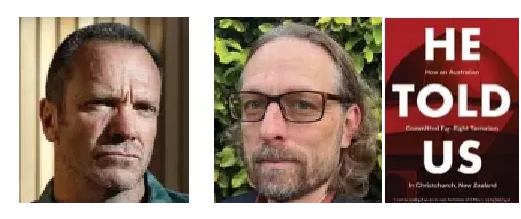
He Told Us , by Auckland academics Chris Wilson and Michal Dziwulski, examines the appalling crimes of Australian terrorist Brenton Tarrant, and what came before and after them. It interrogates the official narrative of what happened and finds it wanting. In particular, it takes aim at the milquetoast Royal Commission of Inquiry, which the authors conclude was at best limited and at worst incurious.
“[We] just end up with this very, very weak analysis and weak conclusions about something that’s so significant,” Dziwulski said.
At the heart of the book is the startling revelation that Wilson, Dziwulski and some research colleagues were able to identify hundreds of posts by Tarrant on extremist websites that our intelligence agencies apparently had not. These, they argue, present the clearest evidence of how an angry and terminally online young man became radicalised and why an official inquiry unaware of their existence was in no position to reason on that point. (A coronial inquiry, still ongoing, has ordered the pair to hand over all their research, Wilson said.)
The discovery was triggered by an initial scepticism of the commission’s findings. Particularly its apparent acceptance of Tarrant’s claim that he didn’t really use extreme right-wing websites, and was largely radicalised by watching YouTube videos.
“The Royal Commission took that at face value,” Wilson said. “That would be very unusual for somebody like him.”
So, after getting ethics approval from the University of Auckland (Wilson is an associate professor; Dziwulski a master’s student), the authors took known samples of Tarrant’s writing and used characteristics – language, style, spelling mistakes – to identify archived posts on sites such as 4chan and 8chan. [An exclusive extract from their book, detailing how they did this, appears in today’s Press].
It turned out the terrorist had been a frequent contributor. “It was surprising to find him so easily, initially,” Dziwulski said. “That research was then the foundation of looking into all of the other elements of attack … [that’s] where the book broadened and looks at a much greater perspective of the whole event.”
That perspective offered some troubling conclusions about how little we know, and may ever know, about what led to the Christchurch terror attacks. The book reveals that most of the evidence the commission heard is permanently suppressed, and that its terms of reference were quietly narrowed before it convened, diverting its focus from what ‘could or should’ have been known about Tarrant.
“So there isn’t actually any impetus for the Royal Commission to take much stock into what there could have been,” Dziwulski said. “[Security agencies] can do a search on their databases and see what information they have about him. So then you’re setting up an inquiry for something that’s effectively already known.”
“And there’s a broader question in terms of how much he’s examined. It’s not just the, ‘Let’s not use his name’, but it’s almost like, let’s not really ask, ‘Did the Royal Commission do a good job?’ Let’s not think about how the attack was able to happen. Let’s not think about how he prepared and how he behaved …This was an inquiry that [supposedly] left no stone unturned into how the attack had occurred. We’ve demonstrated that it wasn’t.”
He Told Us doesn’t apportion blame (Wilson acknowledged that, even if all the information they discovered was known in advance, it still would have been “very difficult” to identify and intercept Tarrant before the attack). But it does look to dismantle some of the official narrative and ask questions there may be little appetite to answer.
“Somebody,” Wilson said, “And I’m not going to name their name, but somebody said to us during the project, ‘New Zealand doesn’t have a culture of inquiry’. We don’t really examine things in depth and people don’t put their heads up above the parapet. It’s almost as though people are slightly concerned about job security and, and everybody knows everybody, and so everything’s a little bit protected. And so we’re not really willing to learn the lessons that need to be learned.”
The dismantling extends to the terrorist himself. In particular, his odious claim that he was just a working-class Aussie bloke concerned about immigration who engaged in violence reluctantly and as a last resort. “That was just a lie,” Wilson said. “That and all of these other lies were designed to gain sympathy from people who otherwise would find his violence abhorrent … And so for us, it was really, really crucial to be able to undermine that propaganda.”
That propaganda has succeeded more than we might like to admit, especially as the mainstream professes to forget about the terrorist, or even say his name. Towards the end of the book, Wilson and Dziwulski list a disturbing number of attacks that either mirrored Christchurch or outright name-checked Tarrant. There are more, like the mosque shooting in San Diego last month, that were too late for publication. Performative shunning can have unintended consequences.
“Ignoring him has plat formed him more effectively than any number of interviews or dissection of why he did what he did,” Wilson said. “It’s left this vacuum of information within which he’s being sanctified and glorified and treated like this outlaw. It’s been pretty counter-productive.
“He’s now the most influential far-right terrorist in history. What we’ve tried to do in the book is to show, through his posts … that he shouldn’t be somebody that you want to emulate.
“He’s actually just a loser.” …
Developing a method
It was very likely that the man who attacked and murdered so many innocent people in Christchurch had been a user of 4chan, 8chan or a similar website.
Many with extreme far-right views use those sites, and he had made it very clear in his manifesto that he was one of them.
The problem was that posting on 4chan is completely anonymous. To use the site, people are not required to register or log in and so have no username. Instead, some boards like /pol/ assign users a random ‘Unique ID’, which appears beside any post they make in a particular thread. When they post in a different thread, they are assigned a new ID.
On a site on which mockery, abuse and trolling are rife, having your identity known means running the risk of having your address or other details publicly released, and this deters almost all users from identifying themselves.
Almost everyone simply uses the name ‘Anonymous’, and the community refers to its members as ‘anons’.
To find the terrorist’s previous online activity, therefore, we had to develop a way of identifying his writing from among millions of anonymous posts.
Beginning in late 2023, we developed a method for doing so. In this task we had the benefit of hindsight: we were able to use information about him and his travel that had been gathered by journalists and investigators and released by the Royal Commission.
We could also analyse the particular ways he wrote by examining his manifesto, as well as posts he had written online under his own name long before his attack. These gave us insights into not just his opinions, but also – crucially for the task of identifying him online – his language and style of writing.
Typographical quirks
Just as Ted Kaczynski’s letters to his brother allowed him to be identified, the terrorist left a clear digital footprint: pieces of writing that we know he authored, including his manifesto and older online posts. In these documents, we noticed several striking oddities in the grammar and punctuation he uses when typing, particularly in hurried or less self-aware moments.
The most noticeable of these is his habit of omitting a space after a full stop, comma or bracket. He often places the first word of the next sentence directly after the punctuation, with no space in between.
Why he does this is unclear, but the idiosyncrasy is rare. We used randomly generated datasets of online posts to check the frequency with which the omission of a space occurs and found that it happens in only one out of every 500 posts.
The terrorist frequently made several other distinctive errors. He combined words into odd and incorrect contractions, for example ‘atleast’. He used capitals incorrectly and seemingly randomly, as in ‘United states’.
We identified this style in things that we know he wrote and could then locate it in the online posts he wrote anonymously.
Travel
The next piece of information we could use to find his posting was location. For much of the period between 2014 and 2018, the terrorist used the inheritance he had received from his father to travel the world. He left Australia on April 15, 2014, telling people online that his travel might last for up to 20 years.
He travelled through Asia, the Middle East, Latin America and Africa, returning to Australia for brief visits before moving to New Zealand in August 2017. Even while based in New Zealand, he continued to travel overseas. Overall, he visited between 60 and 70 countries.
He often sought to visit out-of-the-way locations that do not feature on most Western backpackers’ itineraries.
He visited Georgia, Russia, North Korea, China, Myanmar and Kyrgyzstan, along with more common destinations such as India, Thailand and France. He visited Kenya for five days, Tanzania for eight days, Zambia for two days, Botswana for one day, Zimbabwe for three days, Botswana again for five days, Namibia for 10 days and South Africa for six days.
As a result, he spent time in many locations that are unusual for an Englishspeaking poster on 4chan. We have his itinerary, provided in the Royal Commission’s report, including entry and exit dates for all countries (except his entry date into Iran, which is stated as unknown). We therefore know with near certainty where he was – at least which country he was in – on any particular date between 2014 and 2019. This information has been crucial in identifying his anonymous online posting.
Posts on 4chan display the time and date they were posted, and (at least since December 2014) the /pol/ board shows where the poster is located by placing a country flag beside every post, based on their IP address. Some posters claim to use a VPN – a service that disguises their location – but studies of 4chan show this is rare, perhaps even blocked by the site.
And while the terrorist may have used a VPN for some of his online activities, it quickly became apparent to us that he did not use one when posting on 4chan. In fact, he proudly stated on the site that he did not.
Because we had these two sets of information – where the terrorist was on any particular date, and the country location of the writer of every post on 4chan’s /pol/ – we knew how we might find him.
Self-identification
Further helping our search, the terrorist often provided personal information about himself in his ‘anonymous’ posts.
He stated that he was Australian on numerous occasions, even that he was from Grafton, New South Wales, and that he owned a rental property in Australia …
He listed countries he had already visited, when and for how long he had stayed there, as well as places he was planning on visiting – when and for how long. These posts matched his real itinerary almost exactly, containing information that only he could have known. In fact, these disclosures made it possible to find him on 4chan boards such as /trv/ (Travel) that do not display a country flag.
As he drew closer to his atrocity, his self-identifying statements took on a more confronting tone. Combined with revealing his location, they provided opportunities for his detection.
Once in Dunedin and preparing for his attack, for example, he told other posters he was based in that city, even mentioning the gym he used and how he was enraged by an Islamic school across the road from it.
He sometimes made statements that, after his atrocity on March 15, identify him. In one thread in 2018, he angrily discussed mosques in Christchurch and Ashburton.
Replication of comments in known and anonymous forums
In some cases, the terrorist wrote the same things under his own name (or a known username) and in his anonymous posting on 4chan. This would often occur around the same time.
In 2018, he made posts with nearidentical content on both an Australian far-right group’s Facebook page (the Lads Society) and an anonymous 4chan / pol/ thread. It was in these posts … that he talked about his Dunedin gym and expressed anger about an Islamic school across the road. In both posts, he named the same specific individuals from the local Muslim community (the names he wrote are redacted to protect the privacy and safety of the individuals).
The Royal Commission reported that when interviewed, he said ‘these were the worst of the comments he had posted’. Like much of what he told the commission, this was far from true.
The terrorist also replicated stories and phrases on various anonymous boards on 4chan. For example, on three occasions over three years, he told a story on /trv/ and /pol/ about being questioned in North Korea when carrying a marine EPIRB (a small electronic device used to send a distress signal).
Finding him discussing uncommon topics like this in multiple locations allowed us to add extra words, phrases and errors to our list of search terms.
The terrorist’s posts often contained several of these indicators simultaneously. And because he often posted numerous times in a thread – in some cases, 20 times – there was a lot of opportunity for him to give himself away.
Across multiple posts in a single thread, it was frequently possible to see missing spaces, incorrect contractions, mention of his travel or Australian identity or other self-identification, and distinctive words and terms he used elsewhere. Multiple indicators can be seen in the example posts in the insert.
We maintained a high threshold for including posts in our study. Often we had a strong sense that particular posts were authored by him, but if several indicators were not present we excluded them from our analysis.
Five years of posting on extreme right-wing websites
Just as the FBI taskforce was able to use the Unabomber’s writing to identify him, we used the indicators we had developed to find the terrorist’s anonymous posting. We compiled a dataset of 416 of his 4chan posts, the majority made between 2014 and 2018.
The final post we found was made on March 14, 2019 – the day before his attack.
We combined these 416 previously unknown posts with the approximately 300 posts (written under his name or a known username) that were already known to investigators.
These newly discovered posts tell us a great deal about his opinions, his motivations for his attack and his preparation. We can see his thinking change over time, becoming more radical and more focused on violence …
With this new information, his offline behaviour begins to make more sense and we gain a much clearer picture of his path to violence. Importantly, we can see how his engagement with the /pol/ community contributed to his offline progression towards violence. We can also see how his posting on 4chan became increasingly militant the more he engaged with a highprofile Australian far-right movement.
The posts also undermine many of the claims he made in his manifesto. They show that he was not the reluctant warrior for the white race that he portrayed himself to be, but instead a pathetic fantasist, desperate for respect.
A man who travelled the world on his father’s inheritance but was too nervous to engage with people face to face, choosing instead to sit in physical isolation and interact with strangers online, imagining them to be his friends.
He Told Us: How an Australian committed far-right terrorism in Christchurch, New Zealand, by Chris Wilson and Michal Dziwulski (Allen & Unwin Aotearoa NZ, RRP $37.99). In bookstores nationwide from Monday.


Great content! Keep up the good work!
There’s another review of ‘He Told Us’ at https://chchtruth.com/hetoldus.html.
thanks, chchtruth has a more comprehensive review from one who someone who appears to have both read the book and seen the video. That whole website has more comprehensive coverage of the actual event than Islamic State Watch does.